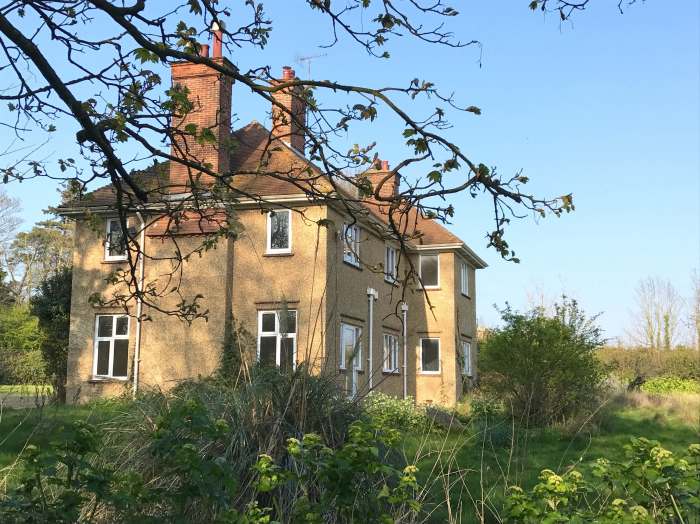
In its current state — threatened with demolition, and awaiting the judgement of the High Court at the end of this month regarding its future — Blakeney’s former Rectory looks rather neglected and unloved. Of course, in truth, it is very dearly loved by many local people, both for its important role in the history of our village, and also for its handsome, old-fashioned, agreeably mellow presence, fitting in so gracefully with the buildings and landscape surrounding it.
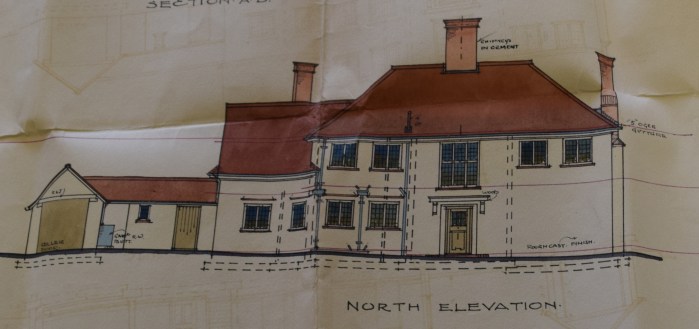
All the same, it might be worth remembering how the New Rectory looked before the Church of England took the bizarre decision to replace its attractive leaded windows with U-PvC ones a few decades ago — indeed, how it looked when it was built in 1925, because other than the removal of its windows, it has changed hardly at all over its 90-something years of existence.
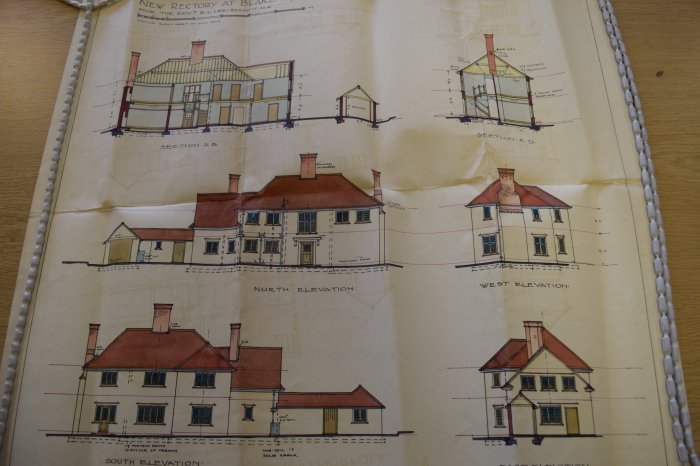
Fortunately, the original drawings for the New Rectory survive in the Church of England archives. Executed by local architect John Page for Holt & Fakenham firm of Holtom & Page in 1924, these drawings were the ones approved by the Rev. David Lee-Elliott, then rector of Blakeney, in the course of commissioning the replacement for what is now the Old Rectory, which was deemed at the time to be too old-fashioned to attract worthwhile incumbents and their families.
The New Rectory was, accordingly, designed to include all sorts of up-to-date, ‘modern’ features, to make it — as estate agents would put it these days — fit for contemporary living. This is why it has very compact service rooms, an integral boiler house for central heating, and plenty of bathrooms. Quite remarkably, all these features survive in the house to this day. Best of all, a built-in garage was part of the scheme, gracefully integrated into the Queen Anne revival / late Arts & Crafts design, on the assumption that any up-to-date rector would certainly run a motor-car. In this sense, the New Rectory is a fascinating essay in the social history of the parish, as well as well-designed, attractive house.
Anyway, here is John Page’s plan for the different elevations of the New Rectory:
And here are his floorplans. Anyone who has been inside the New Rectory during its long career as our village parsonage, or who knows the 2014 sale particulars, will recognise that the 1924 floorplan is basically unchanged.

(These documents are in the collection of the Church of England Record Centre, Bermondsey, London SE16.)
Given this building’s history, its remarkably unspoilt condition and its popularity amongst local people, it is quite remarkable that individuals on Blakeney Parish Council and the NNDC Planning Committee had no qualms in approving its demolition and its replacement with a much larger, charmless glass-and-steel trophy home. It is also quite remarkable that such a decision was deemed appropriate, not just in a conservation area (the New Rectory lies within the Glaven Valley conservation area, and is contiguous with the Blakeney conservation area) but also in an Area of Outstanding Natural Beauty (AONB).
Is it right that people in North Norfolk have to put up with a system that puts the needs of developers first, while ignoring our area’s history, heritage and time-mellowed appeal?
If you would like to help us save Blakeney New Rectory, you can do so here.
 North Norfolk Planning Watch
Gd morning. By way of Mirabel Cecil, art work programme I came to yr planning case. I took Norwich city council to JR Cathedral close Listed buildings those of Victorian merit, Applicants wanted to change – more income to ensue. See BRectory pvc windows too – less future maintenance costs say c of e Managers. Lawyers even then were noting that up & down the country vested interests dictate planning outcomes . Are wealthy younger NNfk newcomers now sought with disposable sums ‘re generating it ” ? Planning Officers v Cllrs unpaid, the latter rely on the former who drip feed preferred facts I found. A Section 10 requirement for community funds to offset some planning traffic impacts I did get highlighted as it was SO fiddled to make it disappear. £15300 wd be avoided payment – by the clerics as Applicants. NB why does yr Judge downplay architecture Merit when HE Lists Rectory as Grade ll* from 1953 ? There’s another one ?
LikeLike
Sadly, the New Rectory was demolished in January 2019, and has now been replaced by a strange-looking structure that has very little of north Norfolk about it.
Regarding your final point, though, the building that was demolished was not the Grade II* Old Rectory where we live (a late medieval building that was listed in 1953) but rather the rectory that replaced it in 1924. While Historic England claimed that the New Rectory had little merit, and hence refused to list it, they frankly lied about the fact that it had a completely intact floor plan, significant surviving fixtures and fittings, and its well-documented relationship with the buildings around it (Grade I church, Grade II* Old Rectory, Grade II barn, primary school, school house, etc). Meanwhile the 20th Century Society, SAVE Britain’s Heritage, the Rectory Society and Save Our Parsonages all demanded that it be preserved. I think the judge, unfortunately, relied on Historic England’s flawed, incompetent and unprofessional opinion. And the result is one less historic building in our village.
LikeLike